
How much does a CPA letter cost? If a lender, landlord, or investor asks for a CPA letter, knowing typical ranges and requirements helps you avoid surprise fees and underwriting delays.
A CPA letter is an accountant’s statement about financial information, but the term covers several different services. A comfort or income verification letter is usually a one-page factual statement, whereas a compilation or review is an AICPA engagement that creates formal financial statements and an accompanying report. Lenders and landlords may use terms like “income verification,” “comfort letter,” “CPA attestation,” or “compilation,” so confirm the exact wording they require before you request a quote.
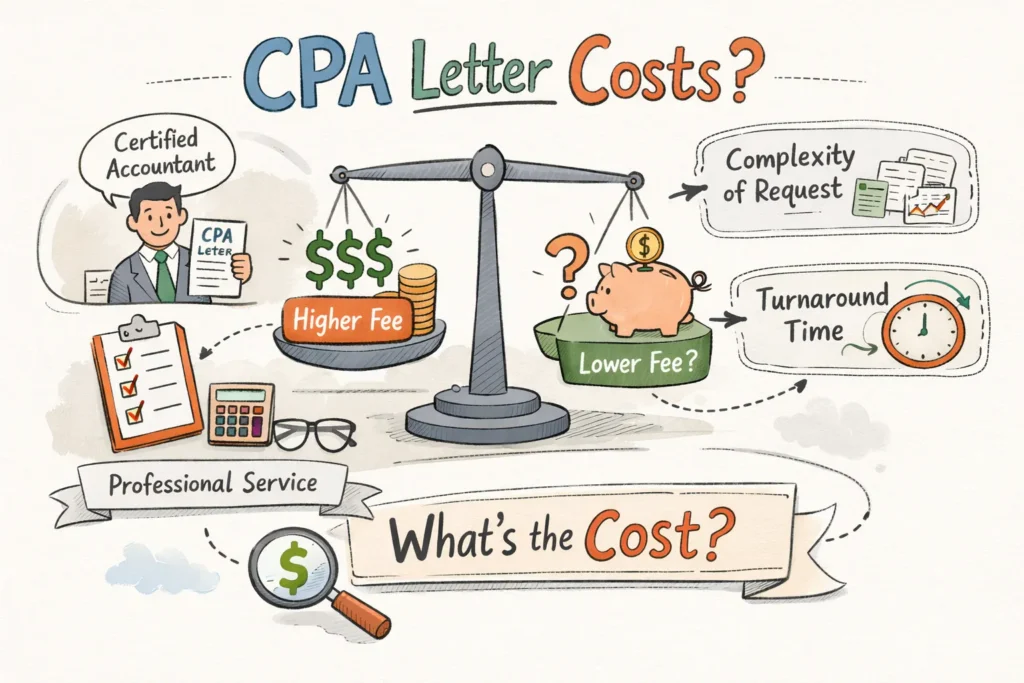
Costs come down to a few predictable factors: complexity of income streams, how complete your books are, CPA experience and liability exposure, the exact wording or procedures requested, and turnaround time. A one-page attestation supported by reconciled profit-and-loss statements and a few bank statements will sit at the low end of the range. Self-employed borrowers with unsynced books, multiple K-1s, or multi-state activity often push fees toward compilation or review pricing. Always ask for an itemized quote so you know whether the fee covers a simple attestation or a formal engagement.
Quick summary
- Price ranges: Simple income or comfort letters typically run $150–$500; compilations and reviews commonly cost $1,500–$5,000+ depending on scope and liability exposure.
- Match the request: Confirm whether the lender needs a one-page attestation or a formal compilation/review, because ordering the wrong service adds cost and delay.
- Prepare documents: Provide signed tax returns, year-to-date profit and loss, a balance sheet, and bank statements to minimize time and fees.
- Ask for itemization: Request flat-fee versus hourly quotes, included procedures, and exact wording so there are no surprise charges.
- Timing matters: Rush turnaround increases fees; plan ahead and bundle requests to negotiate a better rate.
How much does a CPA letter cost? Quick pricing snapshot
Ballpark the costs before you call firms. For simple income verification letters expect roughly $150 to $500, with many practices starting near $150 and more comprehensive letters closer to $300–$500. Compilations commonly fall in the low thousands and reviews typically range from $1,500 to $5,000 depending on complexity. Primary cost drivers include:
- Complex income streams, such as multiple entities, K-1s, or side gigs
- Book completeness and whether reconciliations are required
- CPA experience, firm size, and potential liability exposure
- Custom wording or additional procedures requested by the lender
- Requested turnaround and any expedited service
A one-page lender letter with clean monthly P&Ls generally sits at the low end of the range, while a compilation from disorganized books can add several thousand dollars. Read the lender’s instructions carefully; the next section explains which lenders accept simple letters and which will insist on compilation or review work. If you’re self-employed and want a detailed breakdown by service type, see How Much Does a CPA Letter for the Self-Employed Cost? A Breakdown by Service Type, Ignition Tax Accounting Firm.
Which lenders accept simple letters and when they ask for a compilation or review
Not all lenders treat self-employed income the same. Private or portfolio lenders, some mortgage brokers, landlords, and specialty lenders often accept a simple CPA letter for quick verification of income or self-employed earnings. Those requests usually reflect internal underwriting preferences rather than agency rules, so you see them most with nonconforming loans or stated-income situations.
Certain red flags push lenders to demand a higher level of assurance. Missing or inconsistent tax returns, unusually complex business structures, high loan-to-income ratios, and commercial transactions commonly trigger requests for a compilation or review instead of a simple comfort letter. When a lender asks for conclusions about solvency, net worth, or ongoing cash flow reliability, professional standards require a compilation or review rather than a basic income confirmation.
Confirm exactly what the lender needs before you pay for work. Use a short script when you talk with underwriting: “Please send the exact wording or a sample letter you require, and confirm whether tax returns, bank statements, notarization, or a CPA license number are required.” Then verify these items:
- Request sample wording or a template from the lender
- Ask which documents they will accept
- Confirm delivery method, notarization, and timing
Getting the requirement in writing prevents unnecessary attest work and extra fees. The next section explains how to scope a CPA engagement so you only pay for what the lender actually needs.
Documents CPAs will ask for to prepare the letter (and how to package them)
Missing or poorly organized documents are the most common fee driver. Most firms will ask for your most recent signed tax returns, year-to-date profit and loss and balance sheet, bank statements covering the same period, copies of invoices or rental agreements when relevant, and any K-1s for partnerships. A reconciled P&L that matches your books and month-end reconciliations shaves prep time and often reduces fees.
CPAs will also want proof of the client relationship and basic identity verification before signing a letter. Be ready to provide an engagement confirmation or email, note how long the CPA has prepared your taxes if applicable, and supply ID for notarization when required. The final letter must include the CPA’s full name, license number, and contact information in case the lender requests verification. Lenders often publish specific document checklists; for a concise summary of what self-employed borrowers may be asked to provide, see the NASB guide on what documents do self-employed individuals need for a mortgage.
Package files to reduce back-and-forth and lower billable hours: save reconciled P&Ls and balance sheets as PDFs, label bank statements by month and year, highlight the exact figures the lender asked for, and include a one-page cover note stating the purpose. Add a one-page mapping that ties each lender request to the supporting document and line item to prevent follow-up questions. Efficient packaging usually keeps you toward the lower end of the price range.
After you prepare documents, your CPA can provide a scoped estimate for either a simple attestation or a formal engagement. Clear documentation and upfront instructions help the firm quote accurately and avoid expensive surprises.
Turnaround, rush fees and realistic delivery times
Plan your timeline before you request a letter, because timing often affects cost and available options. Typical turnaround depends on document quality and the CPA’s current workload. If records are complete and straightforward, most simple letters can be delivered in a few business days while compilations and reviews require more time for preparation and procedures.
- Simple letter: 1–5 business days when all documents are ready and numbers are straightforward
- Compilation statement: 1–3 weeks depending on the quality of books, reconciliations required, and statement preparation
- Review or audit-level work: Several weeks to months because of sampling, documentation, and formal reporting requirements
Rush options are common but come at a premium. Expedited pricing for 24–48 hour service typically adds about 25 to 100 percent of the base charge, and same-day requests often carry a larger surcharge. Ask for an exact rush fee upfront and require that the CPA puts the scope and delivery time in the engagement letter to avoid surprises. You can often avoid rush fees by preparing clean, labeled documents, confirming the lender’s exact wording up front, and bundling the letter with ongoing accounting services to reduce marginal cost.
Wording limits, liability and when a CPA must perform a compilation or review
CPAs must stick to verifiable facts and make clear when information was provided by the client. A CPA may confirm that tax returns were prepared, that financial figures came from client records, or that certain dates apply, but they cannot give solvency opinions or positive assurance unless they perform a formal engagement. Avoid language that implies an audit opinion; a simple letter is an attestation of facts, not a promise about future performance.
CPAs must use careful wording. Below are examples of safe and prohibited language to guide conversations with your lender and CPA:
- Safe: “Based on information supplied by the client, we prepared the attached year-to-date profit and loss statement.”
- Prohibited: “The borrower is solvent and will meet all future obligations.”
- Prohibited: “We have audited these financials and offer positive assurance.”
Professional standards affecting when higher-assurance work is required are discussed in auditing standards such as PCAOB auditing standard AS 6101. Compilations apply accounting principles to client data and provide no assurance, while reviews offer limited assurance through inquiry and analytical procedures. Because compilations and reviews involve reconciliations, testing, and documentation, they raise the CPA letter price compared with a simple income verification. For additional professional discussion of the differences between an audit, review, and compilation, see this Journal of Accountancy coverage.
- Template 1: “We prepared the attached financial statements from records provided by the client; no assurance is expressed.”
- Template 2: “Tax returns for the years shown were prepared by our firm.”
- Negotiation line: “Can you accept a statement that our P&L figures are client-supplied and the CPA expresses no assurance?”
Have the CPA submit the agreed text to the lender in writing so scope and expectations are clear. That simple step often prevents follow-up requests and additional fees.
How to get the best rate: negotiation, packaging and safer alternatives
Small changes to how you request a letter can reduce fees. Use a short checklist when you request quotes: confirm flat fee versus hourly pricing, what procedures are included, the turnaround, and any extra charges. Negotiating a capped flat fee with one revision and a specified delivery window reduces uncertainty and avoids surprise hourly bills.
- Flat fee versus hourly and how many revisions are included
- Specific procedures and sample deliverables (exact wording or signed statement)
- Rush fees, liability limits, and whether the CPA will stand behind the statement
- Required documentation the CPA will need and expected turnaround
Use a short script on the first call: “Please provide a capped flat fee for income verification, one revision, and a two-business-day turnaround, and include it in the engagement letter.” Packaging the letter with bookkeeping or annual tax work lowers overall cost because fixed-fee arrangements remove surprises and streamline access to records. Some firms include flat-fee CPA letter services inside accounting packages, which can be a predictable option for real estate professionals, freelancers, and small businesses.
Safer alternatives lenders often accept in place of a signed CPA attestation include signed tax returns, IRS tax transcripts, bank statements showing recurring deposits, or a verified profit and loss signed by a CPA if the lender allows it. Hand your CPA a one-page checklist that lists purpose, required wording, documents provided, desired turnaround, and your contact details so they can quote accurately. For additional pricing context and alternative options, see Cost of a CPA Income Verification Letter & Best Alternatives. Also review examples of lender document requests at The Federal Savings Bank’s guide on what income verification documents might a home lender ask for.