Qualifying for a mortgage is already a detailed process, but it becomes even more challenging when you don’t have traditional tax returns to submit. Many self-employed individuals, small business owners, and people who earn income through online advertising, e-commerce, or non-traditional streams often struggle to provide standard proof of income.
In these situations, a CPA Letter for mortgage can play a significant role in supporting the application. While a CPA letter cannot replace tax returns entirely, it offers lenders an independent, legally recognized confirmation of your income, business activity, and financial stability.
This guide explains how the process works, why lenders allow alternative documentation, and how a Certified Public Accountant (CPA) can help you prepare a strong application even when tax returns aren’t available.
Why Some Borrowers Don’t Have Traditional Tax Returns
Not every borrower fits neatly into a W-2 or standard tax filing timeline. Several groups commonly face this issue:
Self-Employed Individuals With Irregular Filing Patterns
Some business owners file extensions or experience delays due to complex financial records, audits, or restructuring.
Those Making Money Online
Borrowers earning through:
- Cost per Click (CPC) advertising
- Cost per Mille (CPM) internet advertising
- Cost per Action (CPA) affiliate programs
- Social media monetization
- Online marketing or e-commerce
may not have consistent year-over-year tax records early in their business journey.
Newly Formed Companies
A company less than a year old may not yet have filed taxes but can still demonstrate income through bank statements, invoices, and CPA verification.
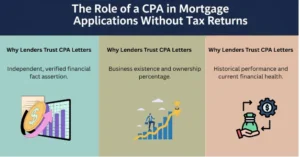
The Role of a CPA in Mortgage Applications Without Tax Returns
A Certified Public Accountant (CPA) is a financial professional who has passed a rigorous legal professional qualification exam involving auditing, tax law, ethics, and accounting knowledge. Lenders view CPAs as credible, independent sources capable of verifying business activity and income.
Why Lenders Trust CPA Letters
A CPA’s work is governed by:
- Legal standards
- Professional ethics
- Auditing principles
- Accuracy and objectivity
Their analysis is not based on rote memorization or subjective guesses, it’s grounded in documented financial data.
What a CPA Letter for mortgage Can Confirm
Your Business Activity
The CPA can verify:
- Your company name
- Industry
- How long you’ve operated
- Whether the business is active
Your Income Records
Rather than relying on tax returns, the CPA may review:
- Bank deposits
- Invoices
- Bookkeeping records
- Online advertising payouts (CPC, CPM, CPA)
- E-commerce transaction summaries
Financial Quality and Internal Controls
CPAs can describe the general quality of your accounting records without making subjective promises or guarantees.
What a CPA Cannot State in the Letter
To comply with professional guidelines, a CPA cannot:
- Predict future income
- Guarantee loan repayment ability
- Offer opinions not grounded in documented data
- Inflate earnings or estimate undocumented revenue
Their role is strictly factual.
What Lenders Look for in a CPA Letter When Tax Returns Are Missing
While requirements vary between lenders, most underwriters look for similar components.
Business Verification Details
Underwriters want to confirm:
- Your identity
- The business structure (sole proprietor, LLC, corporation)
- Years in operation
- Management and ownership
Confirmation of Data Reviewed
A strong CPA Letter for mortgage references the specific documents the CPA reviewed, such as:
- Bookkeeping systems
- Bank statements
- Audit or review materials
- Advertising platform payouts
- Merchant account statements
Consistency Between Business Activity and Income
Lenders assess whether:
- The income level aligns with the business type
- Advertising revenue (CPC, CPM) appears stable
- E-commerce sales are recurring rather than one-time events
Consistency matters more than the size of the income.
How to Prepare Before Requesting a CPA Letter
Organize Every Income Source
Gather:
- Payment screenshots from advertising networks
- Merchant account history
- Invoices
- Monthly revenue summaries
- Accounting software reports
Review Bookkeeping for Accuracy
A CPA can only confirm what is documented. If your financial tracking is incomplete, update records before the CPA review.
Understand the CPA’s Responsibilities
They must follow:
- Tax law
- Ethical requirements
- Accounting standards
- Audit guidance
This ensures the lender receives credible, legally compliant information.
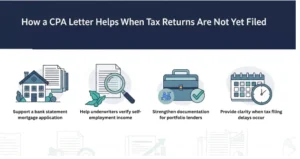
How a CPA Letter Helps When Tax Returns Are Not Yet Filed
A CPA letter does not replace tax returns, but it can:
- Support a bank statement mortgage application
- Help underwriters verify self-employment income
- Strengthen documentation for portfolio lenders
- Provide clarity when tax filing delays occur
For many borrowers in digital marketing, online advertising, e-commerce, or small business management, this letter becomes one of the key documents in the file.