
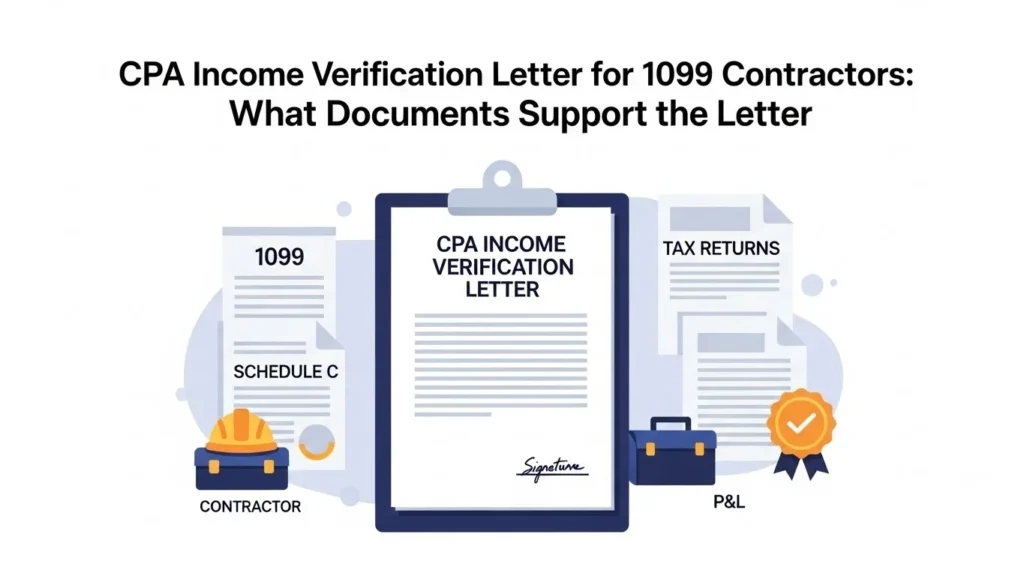
If you are a 1099 contractor, proof of income rarely fits into one document.
Your income may change month to month.
You may have more than one client.
You may also have business expenses that reduce taxable income.
That is why a lender or landlord may ask for a CPA income verification letter for 1099 income.
They want a clear summary that matches real records.
They also want the income period stated in a way that fits the loan application or apartment lease timeline.
This article explains what documents usually support the letter, how a CPA reviews them, and how to prepare a clean file for faster acceptance.
It also covers when an income verification letter for self-employed from CPA makes sense for contractors who are treated as self-employed.
Why 1099 Income Gets Extra Review
1099 income is common, but it is not “fixed salary” income.
That changes how reviewers evaluate it.
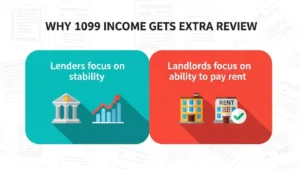
Lenders focus on stability
A mortgage lender or loan underwriter often looks for patterns.
They want to see that income is consistent enough to support the payment.
Landlords focus on ability to pay rent
A landlord or property management company wants proof you can pay rent on time.
They may move quickly, especially for an apartment lease.
They may still request detailed proof if income is variable.
In both cases, the goal is the same.
Clear proof of income tied to documents.
What a CPA Income Verification Letter for 1099 Income Typically Includes
A CPA letter is not a replacement for your records.
It is a summary of the records reviewed.
A typical letter includes:
- CPA letterhead with contact information
- Date and recipient line when provided
- Client name and a clear income period
- Summary of 1099 income and how it was supported
- List of documents reviewed
- Client authorization statement when required
- CPA signature, and licensed CPA identification when needed
- A simple limitations statement that keeps the scope accurate
The letter should be easy to scan.
It should avoid unclear claims.
It should stay within professional standards.
The Core Documents That Support 1099 Income
When someone requests a CPA letter, they usually want to know the basis for the numbers.
These are the documents that most often matter.
1099 forms
1099 forms show gross payments from clients.
They help confirm who paid you and how much.
What 1099 forms do well
- Show payers and amounts
- Support income sources
- Provide a simple year-based summary
What 1099 forms do not show
- Business expenses
- Net income
- How income was reported on tax returns
That is why lenders and landlords usually want more than just 1099s.
Tax returns
Tax returns show how income was reported.
This is often the most trusted “big picture” record for a defined year.
Why tax returns matter
- They establish a clear income period
- They show reported income and deductions
- They tie income sources into one filing
If you are a 1099 contractor, the tax return usually includes details of self-employment income.
Schedule C
Schedule C is common for sole proprietor contractors.
It shows business income and business expenses.
Why Schedule C matters for 1099 income
Many reviewers care about net profit, not gross receipts.
Schedule C shows the relationship between revenue and expenses.
If your income varies, Schedule C helps explain the year in a way a lender can use.
Profit and loss statement (P&L)
A current P&L is often requested when the reviewer wants recent performance.
This is common when the most recent tax return is older than the current year.
What a P&L helps support
- Current income period activity
- Recent revenue trend
- Recent expense trend
A P&L should match business records.
It should also state the exact period it covers.
Business records
Business records support your P&L.
This may include bookkeeping reports, invoices, or payment summaries.
Why business records matter
They provide backup for the numbers.
They also reduce questions when totals appear inconsistent.
Bank statements
Bank statements may be requested, especially in mortgage lender files.
They can help show deposit patterns.
Important note on bank statements
Deposits are not the same as taxable income.
They can support cash flow, but they do not show business expenses.
If bank statements are reviewed, the CPA letter should say so clearly.
If they are not reviewed, it should not imply they were.
How a CPA Reviews a 1099 Contractor File
A good review is structured.
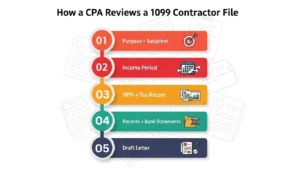
Step 1: Confirm the purpose and recipient
The recipient matters.
A loan application often needs different wording than an apartment lease package.
Common recipients include:
- Mortgage lender underwriting team
- Bank or lender review team
- Landlord or property management company
Step 2: Confirm the income period
The income period is one of the biggest acceptance factors.
The CPA should align the letter period to the request, such as:
- Last filed tax year
- Last 12 months
- Year-to-date with a defined start date
Step 3: Review 1099 forms and compare to the return
The CPA checks that 1099 income sources align with reported income.
If there are differences, the CPA may ask for context.
Step 4: Review Schedule C and the P&L when needed
For many 1099 contractors, Schedule C is central.
A current P&L supports more recent periods.
Step 5: Cross-check business records and bank statements, when applicable
This is typically a consistency check.
It should be described as such.
It should not be written like an audit.
Step 6: Draft the letter with clear scope language
The letter should say what documents were reviewed.
Why This Often Falls Under “Self-Employed” Income
Many 1099 contractors are treated as self-employed for income verification purposes.
That is why an income verification letter for self-employed from CPA may be the same request in different words.
If your pay comes through 1099s, your proof of income often relies on:
- Tax returns
- Schedule C
- Current P&L
- Business records
- Bank statements when requested
So the documentation set is similar.
The difference is the emphasis on the 1099 sources.
What Lenders and Landlords Commonly Request
Loan application and mortgage lender requests
A mortgage lender often wants:
- Tax returns for one or more years
- 1099 forms
- Schedule C if applicable
- A current profit and loss statement (P&L) for the current year
- Bank statements in some cases
Mortgage lender requests often come as “conditions.”
If the condition asks for a CPA letter, it usually means the lender wants a clear summary tied to records.
Landlord requests for an apartment lease
For an apartment lease, a landlord may ask for:
- Proof of income letter
- Tax returns
- 1099 forms
- P&L
- Bank statements if required by the building
Landlords often work on short timelines.
A clean package matters.
Common Reasons Reviewers Ask for Changes
Most issues are easy to fix when you know what reviewers look for.
These are the most common reasons a landlord, mortgage lender, or bank underwriter asks for a revision.
Missing income period
If the letter does not state the income period, the reviewer cannot match it to the file.
A clear date range or tax year keeps the review moving.
No list of documents reviewed
Reviewers want to see what supports the income figure.
Listing the documents reviewed makes the letter easier to validate.
Gross vs net income is not labeled
A 1099 usually reflects gross payments.
Schedule C often reflects net profit after documented expenses.
The letter should clearly label which income basis is being referenced.
Names or dates do not match across records
Review teams compare details across the package.
Small differences in names, dates, or periods can trigger follow-up questions.
Matching details reduces delays.
Wording that suggests a guarantee
Reviewers look for factual, record-based statements.
A CPA letter should avoid future income promises and should stay within professional standards.
Practical Checklist: What to Gather Before Requesting the Letter
Use this list to build your documentation set.
For most 1099 contractor files
- 1099 forms for the requested year(s)
- Tax returns for the requested year(s)
- Schedule C, if applicable
- Current profit and loss statement(P&L) for the stated income period
- Business records that support the P&L
- Bank statements only if the lender or landlord requests them
- Recipient request details, if provided
Quick consistency check
- Names match across documents
- All pages are included
- The income period matches the request
- Totals are readable
- Your P&L date range is clearly labeled